Steam Carpet Cleaning in Ottawa After Winter: Removing Road Salt, Slush and Deep-Set Grime
Ottawa winters are hard on carpets.
From the first snowfall through the spring thaw, outdoor footwear brings in a mixture of salt, sand, grit and moisture. Some of it stays near the surface and gets picked up by the vacuum. Some gets pushed deeper into the carpet every time someone walks across it.
By spring, you may notice that the carpet around your entrance looks darker than the rest of the room. You might also see a white film after the carpet dries, or find that a spot looks better after cleaning but the mark comes back a few days later.
That doesn’t always mean the carpet is permanently stained. In many cases, there is simply a lot of material in the carpet that normal vacuuming cannot remove.
What Happens to Carpet During an Ottawa Winter?
Most winter carpet problems start at the door.
Snow melts when it comes inside. That moisture can dissolve some of the de-icing material on shoes and carry it into the carpet. Sand and road grit are different. They remain as solid particles and can work their way down into the pile with foot traffic.
This combination is hard on carpet for two reasons.
First, the carpet gets dirty. Second, loose grit can act as an abrasive when it is repeatedly walked on. High-traffic areas can therefore start looking worn even when the carpet isn’t particularly old.
The areas we would expect to take the most abuse include:
- Front entrances and hallways
- Mudrooms
- Areas immediately inside exterior doors
- Stairs leading from garages
- Rugs placed inside entry doors
- Condo and apartment hallway runners
- Commercial entrances and lobbies
The amount of buildup depends heavily on traffic, the type of entrance mat being used, and how often the area is vacuumed.
Is That White Stuff Actually Salt?
Possibly, but you can’t tell for certain just by looking at it.
Road salt can leave a white residue when water evaporates. Other materials can look similar, including detergent left behind from previous cleaning and minerals carried in water.
This matters if you’ve already tried cleaning the carpet and the white marks keep returning.
Adding more cleaning solution isn’t necessarily the answer. If the residue is coming from an earlier cleaning product, for example, adding more product can make the situation worse.
The history of the carpet is useful when figuring this out. Has it been professionally cleaned recently? Has someone used a household carpet cleaner? Does the residue only appear after the carpet gets wet?
Those details can tell you more than the colour of the residue alone.
Why Vacuuming Doesn’t Remove Everything
Vacuuming is still the first thing we recommend.
A good vacuum can remove loose sand, grit and other dry material before it gets worked further into the carpet. That’s particularly important around entrances during the winter.
But vacuuming has an obvious limitation: it can’t pull out material that has dissolved into moisture.
Think of the winter soil as two different problems. There are solid particles that a vacuum can pick up, and there are dissolved materials that require a wet-cleaning process to remove.
That’s why a carpet can be vacuumed regularly and still look dirty after several months of winter traffic.
Regular vacuuming also matters for carpet longevity. Sand and grit left in a busy walkway don’t just make the carpet look dirty. They can contribute to wear as they’re repeatedly crushed and moved around underfoot.
What Does “Steam Cleaning” Mean?
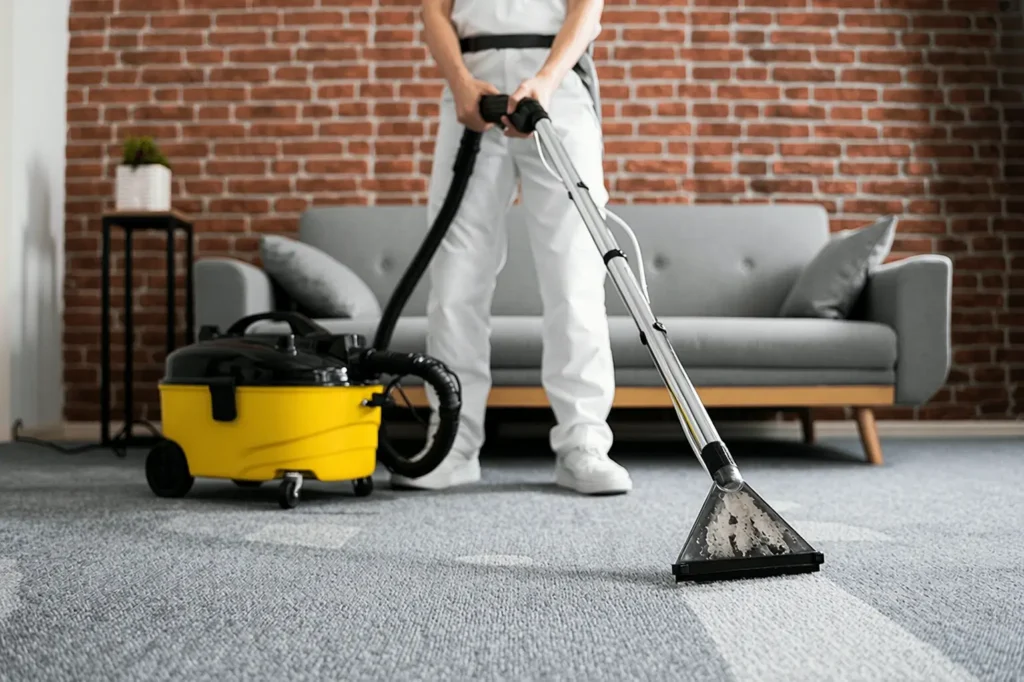
When carpet cleaners talk about steam cleaning, they are usually referring to hot-water extraction.
The name can be confusing because the goal isn’t to fill the carpet with steam.
A typical professional cleaning involves several steps. Loose soil is removed first, a suitable cleaning solution is applied where needed, and the carpet may be agitated depending on its construction and condition. The carpet is then rinsed and the dirty solution is recovered using a powerful vacuum system.
The extraction is an important part of the process.
The objective isn’t simply to put water and cleaner into the carpet. The objective is to loosen the contamination and then remove the resulting liquid from the carpet.
For a heavily trafficked entrance, that can remove material that routine vacuuming cannot.
Can Steam Cleaning Remove Road Salt?
Hot-water extraction can remove water-soluble salt residue when the residue is accessible and the cleaning process includes adequate extraction.
The basic principle is simple: dissolve the residue and extract it.
Salt doesn’t need to be chemically destroyed. It needs to be dissolved and physically removed.
How well that works depends on the situation. A relatively fresh deposit near the surface is different from contamination that has been repeatedly walked into the carpet and re-wetted over several months.
Padding can also change the situation. If a significant amount of moisture has reached the carpet backing or padding, simply cleaning the visible surface may not address the whole problem.
Does Every Carpet Need Steam Cleaning?
No.
Hot-water extraction is useful in many situations, but carpet cleaning isn’t one-size-fits-all.
A lightly soiled carpet that needs a quick maintenance cleaning may be better suited to a low-moisture process. A heavily soiled entrance may benefit from a more thorough extraction.
The carpet itself matters too.
Synthetic carpet is generally quite tolerant of professional wet cleaning, while wool and specialty fibres require more care. Viscose, jute, antique rugs and other delicate materials should not automatically be treated the same way as ordinary wall-to-wall synthetic carpet.
The right method comes down to the material, construction, amount of soil and how much moisture the carpet can safely handle.
What About Wool and Area Rugs?
Area rugs often get a disproportionate amount of winter contamination because they’re placed exactly where people wipe their feet or walk in with wet footwear.
If it’s an inexpensive synthetic rug, cleaning may be relatively straightforward.
A wool rug or an older, expensive or delicate rug is another matter. Dye stability, fibre characteristics, backing and construction all need to be considered before choosing a cleaning method.
This is one situation where experimenting with a strong household cleaner isn’t worth the risk.
If you aren’t sure what a rug is made from, identify the material before treating it.
What You Can Do Yourself
You don’t necessarily need professional carpet cleaning every time winter ends.
Start with the basics.
Vacuum the entrance frequently. Don’t wait until the carpet looks dirty. Regular removal of grit is particularly important during the winter months.
Use a good entrance mat. A mat gives people somewhere to remove moisture and dirt before they reach the carpet.
Keep the mat clean. A saturated or heavily soiled mat can’t do its job effectively.
Blot wet spots. Aggressive scrubbing can spread the contamination and damage carpet fibres.
Be careful with repeated spot treatments. If the same white residue keeps appearing, don’t keep adding more product without figuring out what’s causing it.
And if the carpet is actually wet rather than simply dirty, deal with the moisture first.
What If the Carpet Is Wet?
That’s a different problem from ordinary winter soil.
If melting snow has repeatedly made its way into the carpet, find out where the water is coming from. It could be as simple as wet footwear, but persistent moisture near an exterior door can also point to a drainage, sealing or building-envelope problem.
A carpet that is genuinely wet, especially if the padding is wet as well, needs to be assessed as a moisture issue.
Cleaning a carpet without dealing with the source of the water doesn’t solve the underlying problem.
The same applies to odours. If an odour is coming from contaminated padding or another moisture source, surface cleaning may provide only temporary improvement.
How Long Does Carpet Take to Dry?
There isn’t a single drying time that applies to every carpet.
Drying depends on the carpet construction, padding, amount of moisture used, extraction equipment, temperature, humidity and airflow.
Good extraction makes a difference. So does moving air through the room after cleaning.
A cleaner who tells every customer that their carpet will be dry in exactly the same number of hours is giving you a very general answer. The actual drying time depends on the carpet being cleaned.
After a professional cleaning, fans and normal HVAC circulation can help. Ventilation can also help when outdoor conditions allow it.
What About Commercial Carpet?
The same winter problems occur in offices, retail stores, restaurants, medical facilities, apartment buildings and condominium lobbies, but the volume of traffic can be much higher.
A busy commercial entrance can see more winter contamination in a day than a residential entrance sees in much longer.
Entrance mats are therefore particularly important in commercial spaces. They need to be large enough to capture a meaningful amount of moisture and dirt, and they need to be cleaned or replaced when they become saturated.
Cleaning frequency should also reflect traffic.
A low-traffic office doesn’t necessarily need the same schedule as a busy retail entrance. Some businesses may benefit from maintenance cleaning during the winter and a more thorough cleaning after the season ends.

When Should You Have Your Carpet Cleaned After Winter?
There’s no magic date on the calendar.
For most homes, cleaning after the worst of the snow and slush has passed makes sense because you’re no longer immediately bringing the same amount of winter contamination back inside.
But the condition of the carpet is more important than the date.
Professional cleaning may be worthwhile if:
- The entrance is noticeably darker than the rest of the carpet
- Vacuuming no longer brings the carpet back to a reasonable appearance
- White residue keeps appearing after the carpet dries
- There is a noticeable buildup of grit
- The carpet has developed a persistent odour
- Previous spot cleaning hasn’t produced lasting results
- You’re doing a spring deep clean or preparing a home for sale
If the carpet simply has a little loose sand on it, start with the vacuum.
A Note About “Deep Cleaning”
Deep cleaning shouldn’t mean using as much water or as much chemical as possible.
The objective is to remove the contamination while using a method that’s appropriate for the carpet.
Too little cleaning may leave soil behind. Too much moisture or cleaning solution can create a different set of problems, particularly if extraction is poor or the carpet can’t dry properly.
This is also why a professional cleaning isn’t just about the machine.
The technician needs to identify the carpet, understand what is causing the soiling and choose the cleaning method accordingly.
Frequently Asked Questions
Does steam cleaning remove road salt from carpet?
Hot-water extraction can remove water-soluble salt residue by dissolving it and extracting the resulting solution. How effective it is depends on how much residue is present and how deeply it has moved into the carpet.
Why does white residue come back after cleaning?
The residue could be salt, detergent, minerals or another material. If it repeatedly appears after the carpet gets wet or dries, the source should be investigated rather than assuming it is simply a stain.
Can I remove road salt myself?
Small amounts of surface residue may respond to normal maintenance and appropriate spot cleaning. Larger areas or recurring residue can be more difficult, particularly when the material has migrated into the carpet.
Is hot-water extraction safe for wool?
It can be suitable for some wool carpets, but wool should not automatically be cleaned using the same settings and products used on synthetic carpet. The fibre and construction need to be considered.
How long will carpet take to dry?
It depends on the carpet, padding, amount of moisture, extraction quality and conditions inside the building. There is no universal drying time.
Should I clean carpet that has been soaked by snowmelt?
First determine how much moisture is present and whether the padding is wet. Persistent or substantial moisture should be dealt with before treating the carpet as an ordinary cleaning job.
Is dry carpet cleaning better than steam cleaning?
Neither is automatically better. The appropriate method depends on the carpet, the type and amount of soil, moisture tolerance and the desired drying time.
When is the best time to clean an Ottawa carpet after winter?
For many homes, after the main winter season is over is a practical time. However, if the carpet is heavily soiled, has recurring residue or has developed an odour, there is no particular benefit in waiting for a specific date.
The Bottom Line
Ottawa’s winter carpet problems usually come down to a combination of moisture, grit, salt and traffic.
Start with regular vacuuming and good entrance mats. They do more to protect carpet than many homeowners realize.
When winter soil has accumulated beyond what normal maintenance can handle, professional cleaning can remove material that a vacuum can’t. Hot-water extraction is one option, but it isn’t automatically the right choice for every carpet or rug.
The important thing is to identify what you’re dealing with first.
A dirty synthetic carpet, a wool rug with a recurring white residue and a wet carpet with contaminated padding are three different problems. Treating all three the same way is unlikely to produce the best result.
Good carpet cleaning isn’t about making the carpet as wet or as heavily treated as possible. It’s about removing the soil and residue while protecting the carpet and leaving it in a condition where it can dry properly.